Julius Caesar
"Dictator Perpetuo"
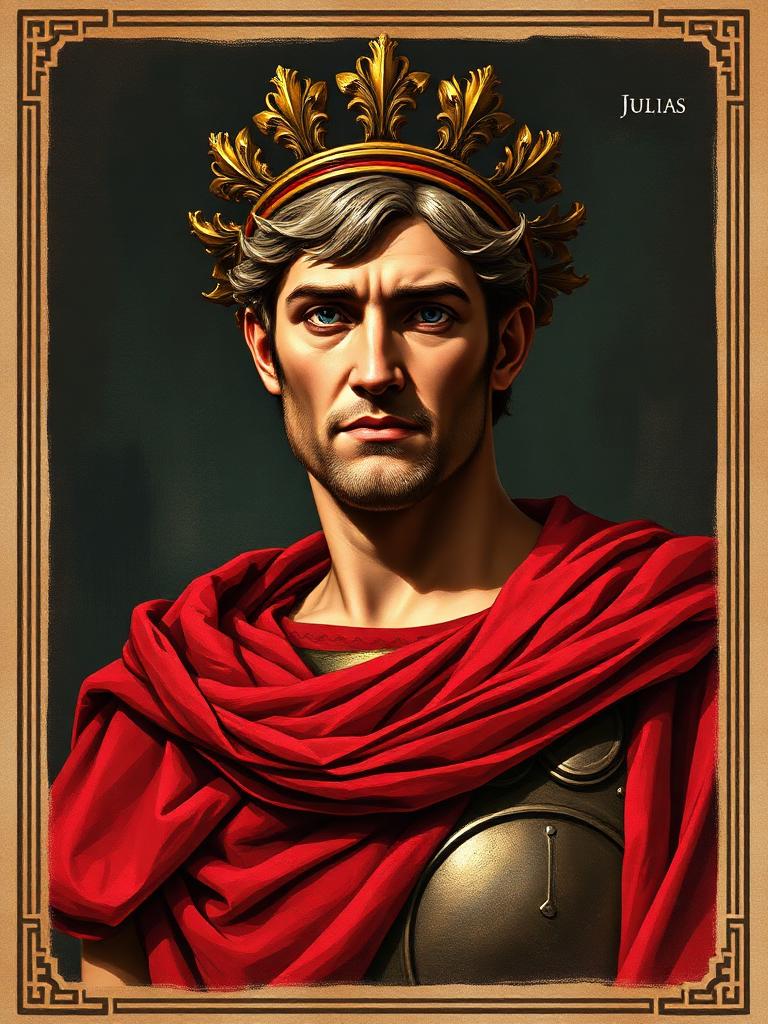
Rome
Once per game: seize an opponent's lane without combat.Rallies Rome — every Rome card gains +1 ATK or +1 DEF while Julius Caesar leads.
ATK
8
DEF
9
CMD
10
The Rules
Four phases. Thirty minutes. One winner takes the throne.
Start each turn by drawing a card and gaining +2 Command Points (CP). You start at 3 CP, capped at 12.
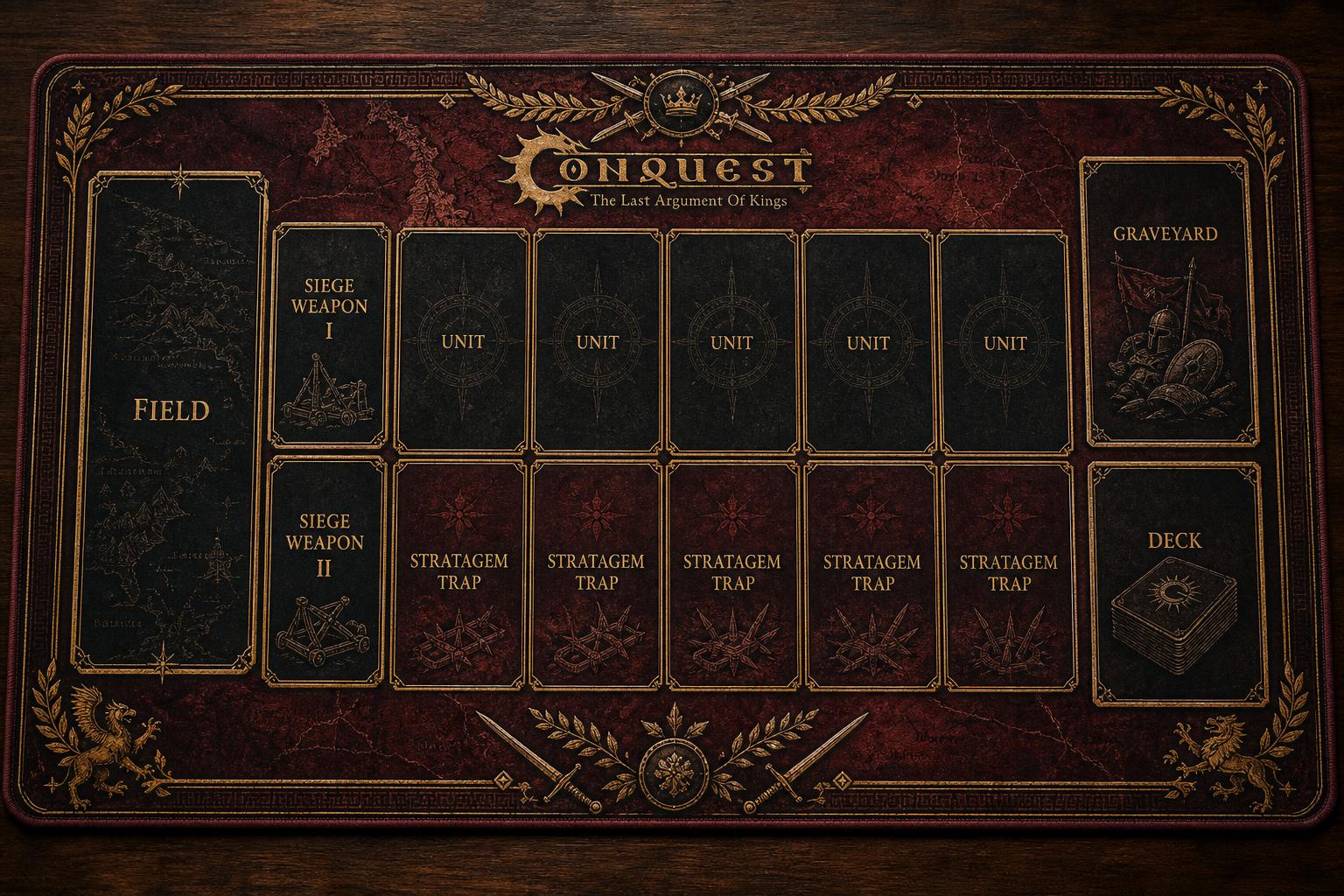
Cards may only be placed in their matching zone: units (including Siege engines) to your 5 Unit slots, Tactics to your 5 Trap slots, and Fields to the single Field zone. Any unit can also be Set face-down for half cost (rounded up). Playing a card on top of an existing one in the same zone destroys the previous occupant — sending it straight to the graveyard.
Each face-up unit in Attack position may strike once. No attacks on your very first turn. Clear enemy units before striking the Commander. Face-down units can't attack — flip them first to surprise charge. When two attacking units clash, the one with the higher ATK survives and the lower-ATK card is destroyed; if their ATK is equal, both fall.
Discard down to 7. Win by reducing your opponent to 0 LP — or by destroying their Commander on the field (Commander Knockout).
Play Area
Unit Zones
5 front-line slots — Reinforcements, Heroes, Siege engines and your Commander all deploy here. There is no separate Commander Zone.
Back Row
5 Tactic (Trap) slots, your active Field, plus a viewable Graveyard.
Your Commander
Sits off-field at game start. Pay their CP cost to deploy into any open Unit slot — kill them and you win the game instantly.
20 Life Points
Reduce to 0 to win.
Command Points
Start 3, +2/turn, cap 12.
Hand · Deck · Graveyard
Hand limit 7. Deck 40+.
Play Open
Pay full cost. Unit enters face-up. Stats and effects are visible to your opponent. Charge units may attack the same turn (except on turn 1).
Set Face-Down
Pay half cost (rounded up, min 1). Unit enters hidden — opponent sees only a card-back. It can't attack. On a later turn, Flip it to reveal: it acts immediately like Charge for a surprise strike. If attacked while face-down, it's revealed and takes the hit without countering.
First Turn Rule
No attacks are allowed on either player's very first turn. Use it to deploy, set traps, and station siege weapons. The fight begins on turn 2.
Battle Positions
Units sit upright in Attack position and rotated sideways in Defense position. Set face-down cards always lay horizontal. During your Main phase you may switch any of your face-up units between Attack and Defense (once per unit per turn, never the turn it deploys). Defenders cannot attack — but when struck, only their DEF is compared to the attacker's ATK; the attacker takes no return damage.
Equal-ATK Clash
When two units in Attack position clash, the one with the higher ATK wins and stays on the field unscathed; the loser is destroyed. If their ATK is equal, both units are destroyed simultaneously. Pick your duels carefully.
Card Effects
Card effects fire automatically — Supply Train and Mass Burial draw 2 cards, Egil and Stone Circle draw 1 on deploy, Valkyrie draws 1 whenever a friendly unit falls, and Ancient Dragon scorches every enemy on entry.
Card Anatomy
A Commander card at a glance — Julius Caesar shown here. The same anatomy reads across every Conquest card.
Julius Caesar — Dictator Perpetuo. The italic flavor line frames the legend before any number is read.
Ten swords mark Caesar as a top-tier Commander. Higher levels unlock heavier abilities and demand bigger tributes.
Pay his Command Point cost to deploy Caesar into one of your 5 Unit slots — there is no separate Commander Zone, so timing matters.
A unique 3-letter prefix + serial (e.g. EAG-001) shows which Starter Deck or Booster the card was first printed in.
"Dictator Perpetuo"
Rome
Once per game: seize an opponent's lane without combat.Rallies Rome — every Rome card gains +1 ATK or +1 DEF while Julius Caesar leads.
Rome. Every Rome card on the board gains +1 ATK or +1 DEF while Caesar leads — your call on each deploy.
ATK strikes, DEF soaks the return blow when defending, and CMD caps the total cost of units you may field each round.
Each Commander bends one rule. Caesar's ability rewards aggressive line-pushes — master it, or lose to it.
The italic line at the foot of every Commander spells out the rally — what every same-faction card gains while they lead.
Card Size
2.5″ × 3.5″ (63.5 × 88.9 mm)
Standard poker size — sleeve-friendly and table-standard. Every card on the website previews at the same 5:7 ratio.
Deck Building
Six card types, one 40-card minimum deck. Mix to match your commander's strengths — your Commander rides on top, not inside.
Soldiers, riders, and beasts. ATK and DEF stats, with traits like Charge, Volley, Guard, Flying, or Siege.
Spells and traps. Play from hand or set face-down to spring on your opponent's turn.
Terrain that rewrites the rules. Only one Field is active at a time — choose your battlefield.
Equip Spells. Attach to a Reinforcement or your Commander for persistent ATK/DEF buffs and combos.
Built structures with their own DEF. Sit in your back row; opponents can attack them directly.
Battlefields, cities and wonders. Capture them for round-by-round bonuses while they stay under your banner.
Rules of construction: 40-card minimum deck · max 3 copies of any single card · 1 Commander chosen separately (deployed into a Unit slot during play, not shuffled in).
Allegiance Synergy. Every card and every commander fights under an Allegiance — Rome, Macedon, China, Carthage in the launch wave. While your Commander leads, every card in your deck sharing their Allegiance gains +1 ATK or +1 DEF (your choice on deploy). Build a mono-faction deck for crushing synergy, or splash Neutral cards (which never gain or lose the bonus) to stay flexible.
Browse all cardsGame Mechanics
Every stat-bearing card is priced against a published curve. It's the invisible math that keeps Conquest fair — and the reason you'll never open a booster and find a card that just wins.
Reinforcements
ATK + DEF ≤ 2 × cost + 2
A 3-cost soldier sits around 8 raw stats (e.g. 4/4, 3/5, 5/3). Anything pushed higher must give up stat budget for an ability.
Strongholds
DEF ≤ 2 × cost
Walls are durable but not free. A 4-cost keep tops out around DEF 8 before its passive starts pulling weight.
Artifacts
+ATK + +DEF ≤ cost + 1
Equips are budgeted as a tax on the unit they boost — the splashier the bonus, the steeper the CP.
Trading-card games live and die on power creep. Without a published curve, every new commander tempts the designer to print "just one stat better" — and within a year the starter decks are obsolete. The curve is a contract: a 3-cost reinforcement will always trade roughly with another 3-cost reinforcement, regardless of which expansion it came from.
Cards may sit up to +1 above the curve to make room for personality — a faction's signature build, a Mythic flourish, or a starter-deck headliner. Anything more must trade stats for a real downside (high cost, harsh activation, single-use clause). On-curve and below-curve cards are fine; their text is what earns them a slot.
Every change to the card library re-runs an automated balance audit: bun run balance:audit. The script walks all Reinforcements, Strongholds, and Artifacts, checks each against its curve, and exits non-zero if any card lands more than +1 above its budget — blocking the build until a designer either nerfs the stats or accepts the deviation.
Step 1 — Edit
Designer touches a card in src/data/cards.ts.
Step 2 — Audit
Suite re-checks all 140+ stat-bearing cards in milliseconds.
Step 3 — Gate
Offenders print with their delta; CI fails until they're addressed.
Current status: 141 cards on or under curve, average Reinforcement budget −1.7 stats below ceiling — designers are deliberately spending stat budget on abilities and flavor rather than raw numbers.
See It In Action
Follow Mira (playing Alexander) and Dev (playing Hannibal) through a full 2-player match. Read it like a story — every rule appears in context.
Mira wins by Commander Knockout — destroying Dev's Hannibal. The other paths to victory are reducing your opponent to 0 Life Points, or making them try to draw from an empty deck. The whole match took about 25 minutes.
Spend every turn — banking 6+ unused CP usually means you've fallen behind in tempo.
Excalibur on a Crossbowman turned a finesse unit into a finisher. Look for two cards that multiply each other.
A face-down Tactic bends your opponent's plans before they're even drawn.
Common Questions